Why Training Your Trapezius Muscles Is Essential
Trapezius exercises are movements designed to strengthen and develop the three distinct regions of your trapezius muscle—the large, diamond-shaped muscle spanning your upper back, shoulders, and neck. Whether you're dealing with neck tension, poor posture, or simply want to build a stronger, more balanced upper body, targeted trap training is essential.
Quick Guide to Trapezius Exercises
Upper Trapezius: Dumbbell shrugs, barbell shrugs, farmer's walks
Middle Trapezius: Bent-over rows, face pulls, prone T-raises
Lower Trapezius: Prone Y-raises, wall slides, seated press-ups
Training Frequency: 2-3 times per week for optimal growth
Key Benefit: Reduces risk of shoulder injury by up to 8.4 times when properly balanced
Your trapezius muscles do far more than you might think. They stabilize your shoulder blades during nearly every upper body movement, help maintain proper posture throughout your day, and play a critical role in preventing the neck and shoulder pain that plagues so many athletes and desk workers alike.
Here's the problem: most people overtrain their upper traps while completely neglecting their middle and lower traps. This imbalance—tight upper traps combined with weak lower traps—is a recipe for chronic neck pain, tension headaches, and even shoulder impingement. Research shows that scapular dyskinesis (abnormal shoulder blade movement) increases your risk of shoulder injury by a staggering 8.4 times [1].
The good news? A well-structured trapezius workout that targets all three regions can dramatically improve your posture, reduce pain, boost your strength in compound lifts like deadlifts and rows, and help you build that coveted V-taper physique.
This guide will walk you through the anatomy of your traps, explain why balanced training matters, and provide you with the most effective exercises for each trap region—backed by research and real-world results. You'll learn how to structure your trap workouts, avoid common mistakes, and manage muscle soreness when it strikes.
I'm Tony Enrico, and at Neuropasil, I've dedicated years to helping athletes and active adults overcome muscle pain and achieve peak performance through targeted relief and evidence-based training strategies. Throughout my career, I've seen how proper trapezius exercises can transform not just how people move, but how they feel every single day.
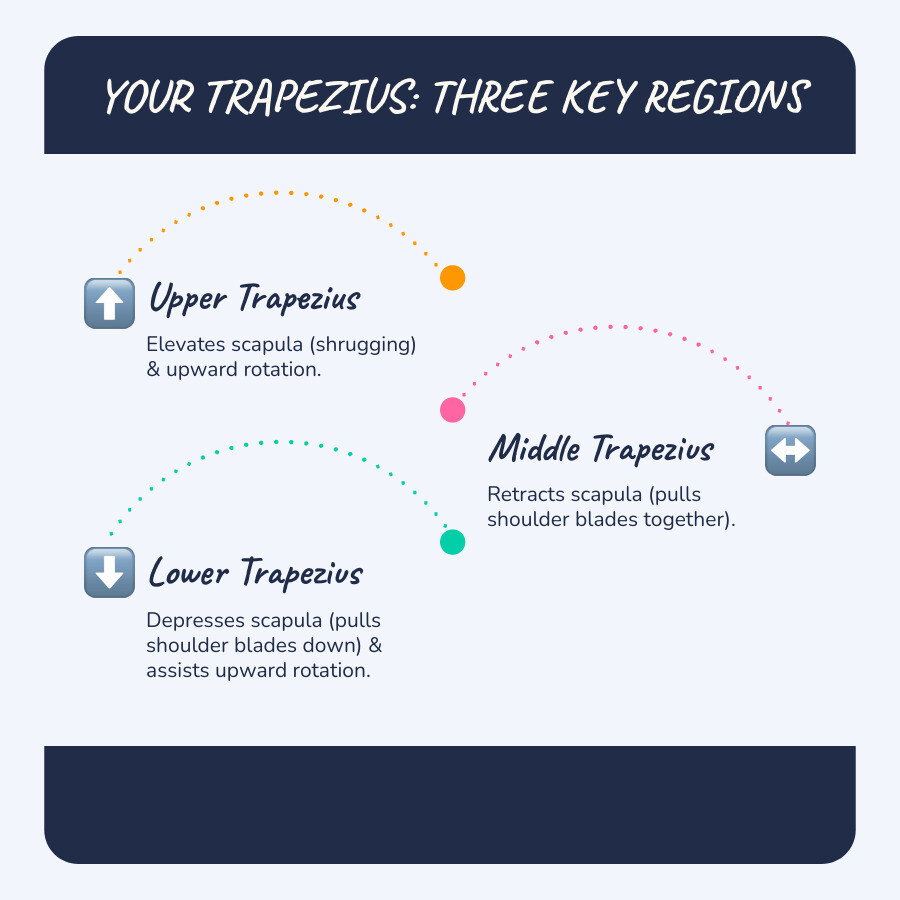
Quick trapezius exercises definitions:
Understanding Your Trapezius: Anatomy and Function
Let's start with the basics. The trapezius muscle, often simply called "the traps," is a large, kite-shaped or quadrilateral-shaped muscle that covers a significant portion of your upper back. It's a superficial muscle, meaning it's close to the surface, stretching from the base of your skull (occipital bone) down to the middle of your spine (lower thoracic vertebrae) and fanning out to your shoulder blades (scapulae) [4]. Think of it as your back's multi-tasker, stabilizing your spine and promoting good posture.
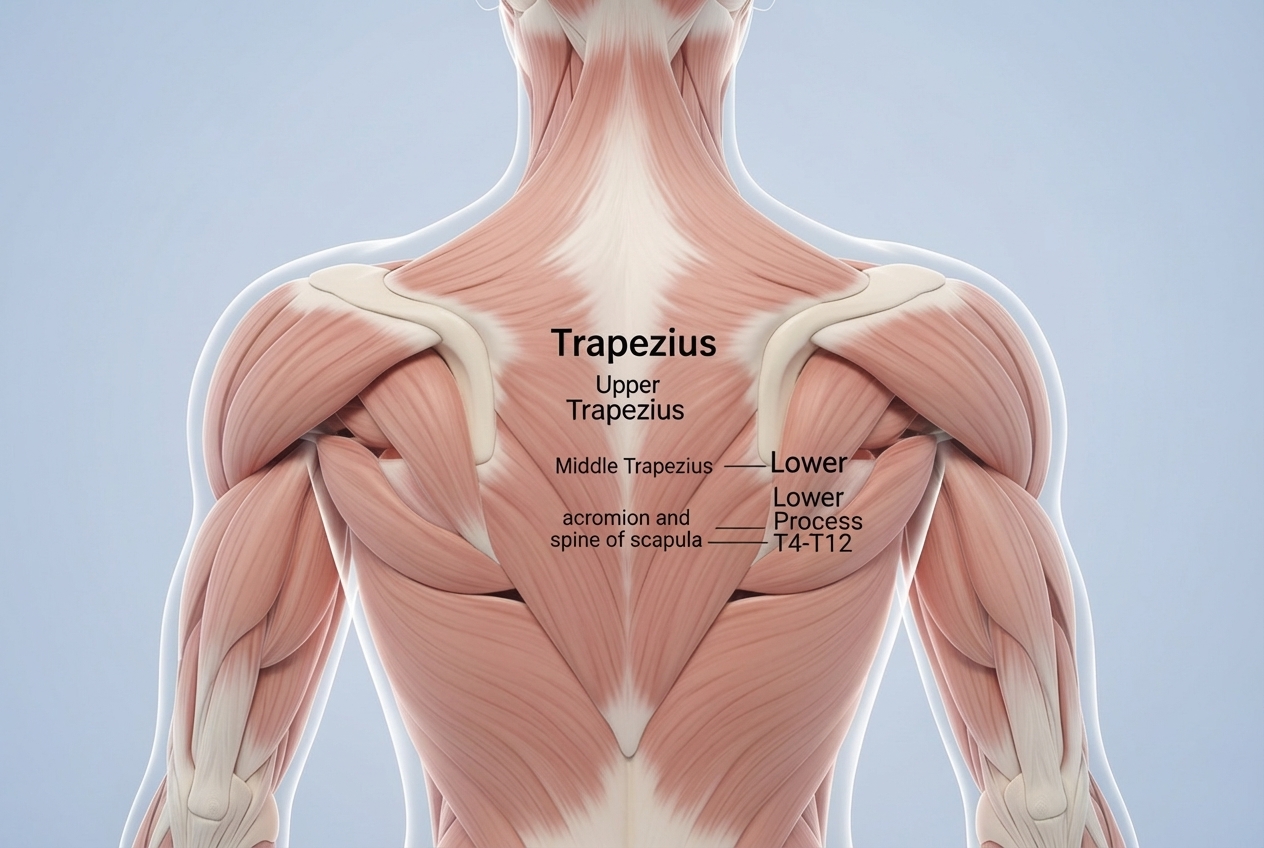
This massive muscle is crucial for shoulder girdle movement and spine stabilization. Without healthy, functioning traps, our ability to move our arms, shrug our shoulders, or even maintain an upright posture would be severely compromised. For a detailed look at its structure, you can explore the Anatomy of the Trapezius muscle.
The Three Parts of the Trapezius
Despite its unified appearance, the trapezius is actually divided into three distinct functional regions:
- Upper Trapezius (UT): Located at the top, running from the base of the skull and neck down to the shoulders.
- Middle Trapezius (MT): Situated between the shoulder blades, extending horizontally across the upper back.
- Lower Trapezius (LT): Found in the mid-back, angling downwards from the shoulder blades towards the spine.
Each of these parts has a specific fiber direction and, consequently, a unique set of actions. You can find more information about its structure and divisions from the Trapezius Muscle Anatomy from Cleveland Clinic.
Primary Functions of Each Trap Region
Understanding the role of each section is key to performing effective trapezius exercises:
- Upper Trapezius (UT): Its primary function is scapular elevation, which is the movement of shrugging your shoulders up towards your ears. It also assists in the upward rotation of the scapula. When you lift your arm overhead, your UT is working hard!
- Middle Trapezius (MT): This section is all about scapular retraction, pulling your shoulder blades together towards your spine. Think of squeezing a pencil between your shoulder blades—that's your middle traps in action. This is essential for good posture and stabilizing your upper back.
- Lower Trapezius (LT): The lower traps are responsible for scapular depression, pulling your shoulder blades downwards. They also play a crucial role in the upward rotation of the scapula, working in synergy with the upper traps to correctly position the shoulder blade during arm movements.
Why Strong Traps Matter: Benefits, Imbalances, and Pain
Why should we care so much about these muscles? Because strong, balanced traps contribute to so much more than just a powerful physique. They are the unsung heroes of our upper body health.
The Benefits of a Balanced Trap Workout
Incorporating well-rounded trapezius exercises into your routine offers a wealth of benefits:
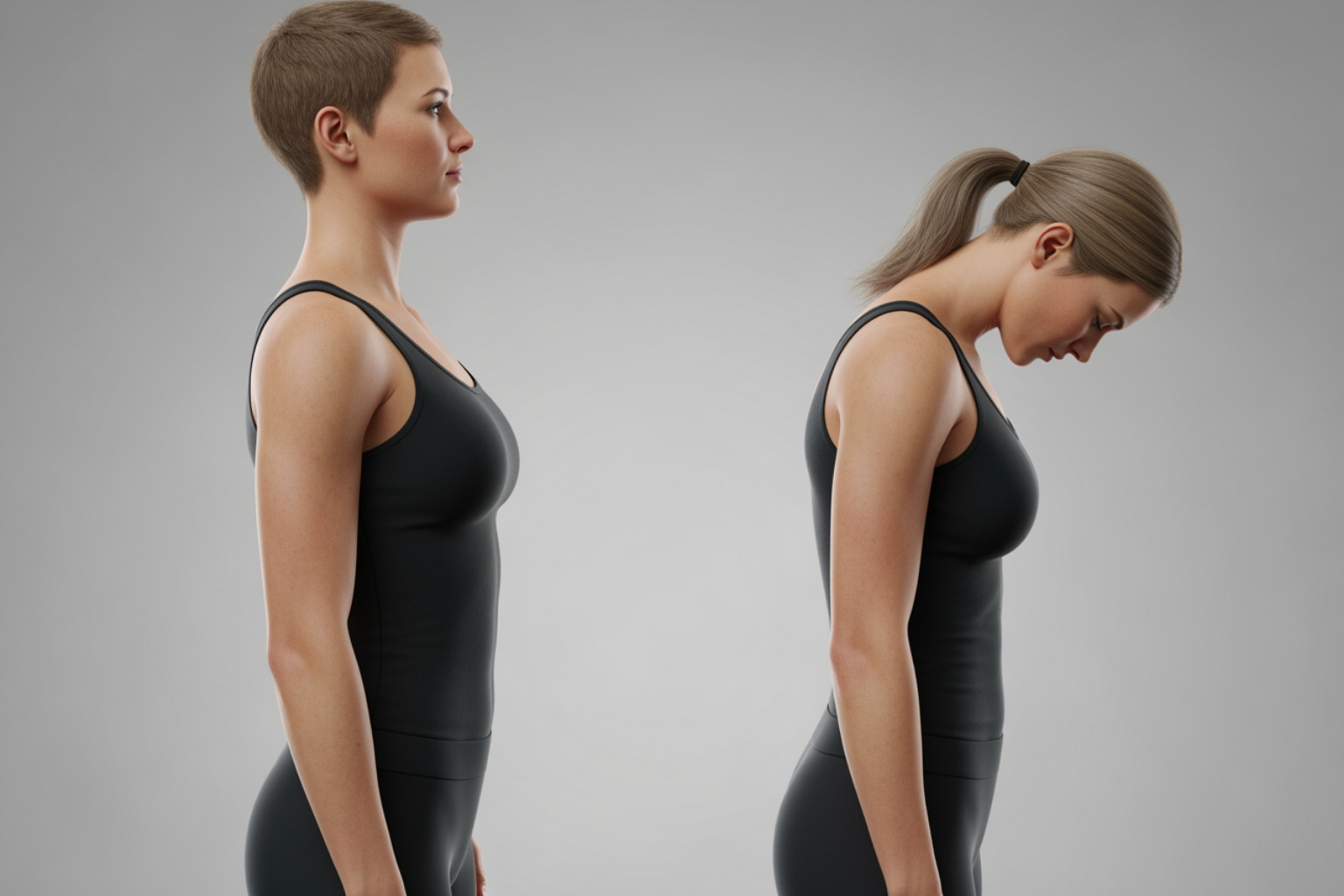
- Improved Posture: Balanced traps help pull your shoulders back and down, counteracting rounded shoulders and forward head posture, which are common issues in our tech-driven world. This stabilization of the spine is vital for a healthy back.
- Reduced Risk of Shoulder Injury: Weakness or poor control of the muscles around the shoulder blade, including the traps, is linked to subacromial impingement, neck pain, and even cervicogenic headaches. A study by Clarsen et al. found that scapular dyskinesis (abnormal shoulder blade movement) increased the risk of shoulder injury in elite handball players by a staggering 8.4 times [1]. Training your traps helps prevent this.
- Increased Strength in Compound Lifts: Strong traps are fundamental for exercises like deadlifts, rack pulls, and rows. They help stabilize your spine and shoulders, allowing you to lift heavier and more safely.
- Aesthetic V-Taper: For those interested in aesthetics, well-developed traps contribute to a strong, athletic V-taper, making your shoulders appear broader and your waist narrower.
- Headache Reduction: By alleviating tension in the neck and shoulders, balanced trap strength can help reduce the frequency and intensity of tension headaches.
Common Issues: Upper Trap Dominance and Weak Lower Traps
Unfortunately, many of us fall into a common imbalance: our upper traps become tight and overactive, while our middle and lower traps are weak and underused. This is often exacerbated by:
- Prolonged Computer and Phone Use: Staring at screens often leads to a "text neck" posture with forward head and liftd shoulders, constantly engaging and tightening the upper traps.
- Stress: When we're stressed, we often unconsciously hike our shoulders up, further tightening the upper traps.
- Neglect in Training: Many workout routines focus heavily on exercises that primarily hit the upper traps (like heavy shrugs) while neglecting the crucial middle and lower regions.
This imbalance can lead to:
- Chronic Neck and Shoulder Pain: The tight upper traps pull the head forward, straining the neck, while weak lower traps fail to properly depress and retract the scapula.
- Shoulder Impingement: The upper and lower traps work together to rotate the glenoid cavity superiorly. However, if this movement is dysfunctional due to imbalance, it can contribute to shoulder impingement and pain [2].
- Headaches: Tension from tight upper traps can radiate up to the head, triggering tension headaches.
The good news is that by consciously focusing on strengthening the often-neglected middle and lower traps, we can correct these imbalances, improve our posture, and significantly reduce pain.
The Ultimate Guide to Effective Trapezius Exercises
Now for the fun part: the exercises! To effectively strengthen your traps, we need a variety of movements that target each of its three distinct regions. Proper form is paramount to maximize muscle activation and prevent injury, regardless of the equipment you're using.
Different types of equipment can offer unique benefits:
- Barbells: Great for heavy compound movements and progressive overload.
- Dumbbells: Excellent for unilateral work, correcting imbalances, and allowing a more natural range of motion.
- Cables: Provide constant tension throughout the entire range of motion, great for isolation and controlled movements.
- Machines: Offer stability and can be good for beginners or for isolating specific muscles without worrying about stabilizing other body parts.
- Bodyweight: Accessible anywhere, focuses on control and muscle endurance.
Let's explore the best exercises for each part of your trapezius. We've included links to detailed MVIC (Maximal Isometric Voluntary Contraction) values for many of these exercises, which are scientific measures of muscle activation, so you know you're getting the most bang for your buck!
Best Exercises for the Upper Trapezius
The upper traps are often the most visually prominent and, for many, the most overtrained. However, they are vital for shoulder stability and powerful movements.
- Dumbbell Shrugs: A classic for a reason. Hold dumbbells at your sides, shrug your shoulders straight up towards your ears, hold briefly, and slowly lower. Focus on keeping your head neutral and avoiding rolling your shoulders. This is a primary mover for scapular elevation.
- Barbell Shrugs: Similar to dumbbell shrugs but allows for heavier loads. Can be performed with a barbell in front or behind the body. Ensure a controlled movement, lifting vertically.
- Farmer's Walk: A fantastic functional exercise. Hold heavy dumbbells or kettlebells in each hand and walk for a set distance or time. This builds isometric strength in your upper traps, core, and grip, promoting overall stability and posture.
- Upright Rows (Use with Caution): While effective for upper traps and deltoids, barbell upright rows can place stress on the shoulder joints. If you perform them, use dumbbells or a wider grip, and only pull the weight to shoulder height, keeping elbows high. We recommend starting light and focusing on form.
- Overhead Shrugs: With a barbell or dumbbells held overhead (like at the top of an overhead press), shrug your shoulders towards your ears. This variation targets the upper traps in a more challenging, stabilizing role.
For more scientific data on how effectively these exercises activate your upper traps, check out this Table of MVIC values for UT exercises.
Best Exercises for the Middle Trapezius
Often overlooked, strong middle traps are crucial for posture, shoulder health, and preventing that dreaded "hunched over" look. These exercises focus on scapular retraction.
- Bent-Over Dumbbell Rows: While a great back exercise, with proper form, bent-over rows heavily engage the middle traps. Focus on pulling your shoulder blades together as you row the dumbbells towards your hips.
- Seated Cable Rows: Similar to dumbbell rows, using a cable machine provides consistent tension. Use a wide grip and focus on initiating the pull by squeezing your shoulder blades together, then letting your arms follow.
- Face Pulls: A favorite of many physical therapists for a good reason. Using a rope attachment on a cable machine, pull the rope towards your face, flaring your elbows out and squeezing your shoulder blades together. This effectively targets the middle and lower traps, as well as the rear deltoids. If done right, the face pull can also hit the lower traps Ebenezer Samuel, C.S.C.S..
- Prone "T" Raises: Lie face down on a bench or the floor with light dumbbells. Extend your arms out to the sides, forming a "T" shape, and lift them by squeezing your shoulder blades together. Keep your thumbs pointing up to encourage external rotation. This exercise is excellent for isolating the middle traps.
- Incline Dumbbell Rows: Lie prone on an incline bench with dumbbells. Row the weights up, again focusing on squeezing your shoulder blades together. The incline position helps to minimize the involvement of the lower back and isolate the middle traps.
Find more about middle trap activation with this Table of MVIC values for MT exercises.
Best Exercises for the Lower Trapezius
The lower traps are arguably the most important for overall shoulder health and often the weakest link. Strengthening them is paramount for good posture and injury prevention. These exercises emphasize scapular depression and upward rotation.
- Prone "Y" Raises: Lie face down on a bench or the floor. With light dumbbells, extend your arms overhead at a 45-degree angle from your body, forming a "Y" shape. Lift your arms by depressing and retracting your shoulder blades. This is a highly effective exercise for the lower traps.
- Wall Slides (or Wall Angels): Stand with your back against a wall, feet shoulder-width apart, and heels slightly away from the wall. Press your lower back into the wall. Place your arms against the wall, elbows bent at 90 degrees, forming a "W" shape. Slowly slide your arms up the wall, keeping your elbows and wrists in contact, moving towards a "Y" shape, then slide back down. This is an excellent bodyweight option for activation.
- Banded Pull-Aparts: Hold a resistance band with both hands, arms extended in front of you at shoulder height. Pull the band apart, squeezing your shoulder blades together and depressing them. This helps reinforce scapular retraction and depression.
- Seated Press-ups: Sit on a sturdy chair or bench. Place your hands on the seat next to your hips, palms down. Push down through your hands, lifting your hips slightly off the seat, engaging your lower traps to depress your shoulder blades. Hold briefly and lower slowly. This activates the lower traps over the upper traps [3].
- Side-Lying External Rotation: Lie on your side with your top arm bent at 90 degrees, elbow resting on your side. Hold a light dumbbell or use a resistance band. Externally rotate your arm upwards, keeping your elbow tucked. This exercise, along with side-lying forward flexion and horizontal abduction with external rotation, has been shown to have optimal UT:LT ratios, making it great for balanced development [2].
For more exercises and their activation levels, consult this Table of MVIC values for LT exercises. You can also find More on Lower Trap Exercises for additional ideas.
Building Your Trap Workout: Frequency, Selection, and Progression
Integrating trapezius exercises into your routine effectively means thinking about frequency, how you select your movements, and how you progress over time.
How Often Should You Do Trapezius Exercises?
We often get asked, "Can I train traps every day?" While the traps are a resilient muscle group, daily training isn't optimal. Muscles need time to recover and grow. Research indicates that training each muscle group 2 or 3 times per week leads to 3.1% greater muscle growth than training just once a week [5]. Specifically for upper body gains, two days a week seems to be the sweet spot. This allows for sufficient recovery and adaptation, leading to better results.
We recommend aiming for 2-3 trap-focused sessions per week, with at least 48 hours of rest in between. This could mean incorporating them into your back day, shoulder day, or even a full-body routine.
Compound vs. Isolation Trapezius Exercises
To build well-rounded traps, we advocate for a mix of both compound and isolation movements:
- Compound Movements: These involve multiple joints and muscle groups. Exercises like deadlifts, rack pulls, and various rows (barbell, dumbbell, cable) heavily engage your traps as secondary movers, especially the middle and lower regions, for stabilization and powerful pulling. The traps are deeply involved in supporting your arms and scapular retraction during these lifts.
- Isolation Movements: These target the trapezius more directly. Think shrugs for the upper traps, and Y-raises, T-raises, or face pulls for the middle and lower traps. These are excellent for focusing on mind-muscle connection and ensuring all parts of the traps get dedicated attention.
While heavy compound lifts will certainly build strong traps, isolation exercises ensure that the often-neglected middle and lower regions receive specific stimulation for balanced development.
Tailoring Exercise Selection to Your Goals
Your personal fitness goals should guide your exercise selection:
- For Posture Correction: Prioritize middle and lower trapezius exercises that emphasize scapular retraction and depression. Think face pulls, prone Y/T raises, and wall slides. These will help pull your shoulders back and down, improving your alignment.
- For Mass and Aesthetics: Focus on a combination of upper trap exercises (shrugs, farmer's walks) for that "power look," alongside middle trap exercises (rows, face pulls) to contribute to a broad, V-taper back. Heavy loads with proper form, combined with higher volume, will be key.
- For Strength: Incorporate heavy compound lifts like deadlifts and rack pulls, where your traps act as crucial stabilizers. Supplement these with strong isolation movements for overall power.
- For Pain Relief: If you're experiencing neck or shoulder pain, the focus should be on activation and light strengthening of the middle and lower traps. Exercises with optimal UT:LT ratios, like side-lying external rotation, are particularly effective [2]. Avoid heavy, high-intensity upper trap work initially, as this might exacerbate imbalances.
Managing Trap Pain and Muscle Soreness
Even with the best form and thoughtful programming, sometimes our muscles get a little grumpy. It's important to understand the difference between normal muscle soreness and a more serious injury.
Soothing Sore Muscles and Aches
After a challenging workout, you might experience Delayed Onset Muscle Soreness (DOMS)—that familiar ache that kicks in a day or two later. DOMS is a normal part of the muscle adaptation process. To soothe these sore muscles and aches:
- Active Recovery: Gentle movement, like a light walk or some dynamic stretching, can increase blood flow and help alleviate stiffness.
- Gentle Stretching: Post-workout stretches, such as the cat-cow or ear-to-shoulder stretches, can help maintain flexibility and reduce tightness.
- Topical Relief: For targeted relief, we find that topical pain relief creams can be incredibly effective. Neuropasil offers natural, fast-acting topical creams for sore muscles, powered by Aloe, Urea, and Menthol. Athletes on our team often use Neuropasil to treat and recover from sore muscles after intense trapezius exercises. Our unique blend provides soothing relief for various types of pain, including the neck and upper back. You can Find the best pain relief creams for muscle pain on our blog.
Common causes of trap strain, beyond overexertion, often include poor form during exercises, prolonged poor posture (e.g., "text neck"), and even stress-induced muscle tension. Gentle stretching and proper form are your best preventative tools!
When to See a Doctor
While most muscle soreness resolves within a week or two, some symptoms warrant professional medical attention. We recommend consulting a healthcare provider if you experience:
- Persistent Pain: Pain that lasts longer than a couple of weeks, even with rest and home remedies.
- Sharp or Shooting Pain: Especially if it radiates down your arm or from the base of your neck.
- Numbness or Tingling: These sensations can indicate nerve involvement.
- Inability to Move: Significant restriction in your neck or shoulder's range of motion.
- Pain When Breathing: Upper back pain that occurs or worsens when you breathe should be evaluated immediately by a medical professional.
For more detailed information on managing trap issues, you can Learn about trapezius muscle strain treatments on our site.
Frequently Asked Questions about Trapezius Exercises
We hear a lot of questions about trapezius exercises, and we're here to clear things up!
Can I train traps every day?
While the traps are a robust muscle, we don't recommend training them every day. Like all muscles, your traps need time to recover and grow stronger after being stimulated. Research consistently shows that training a muscle group 2 to 3 times per week is optimal for muscle growth [5]. This allows for adequate rest and repair, leading to better gains. Aim for at least 48 hours of rest between intense trap sessions.
Do I need to do shrugs to grow my traps?
Not necessarily! While shrugs are excellent isolation exercises for targeting the upper traps, they aren't the only way. Heavy compound exercises like deadlifts, rack pulls, and various rowing movements (barbell, dumbbell, cable) significantly engage your traps as secondary movers, especially the middle and lower regions. These lifts demand a lot from your traps for spinal and shoulder stabilization. So, if you're already incorporating these into your routine, your traps are getting a good workout. Shrugs are a great addition if you want to specifically emphasize upper trap development or add more volume.
How do I fix uneven or imbalanced traps?
Uneven traps are often a result of muscular imbalances, perhaps due to favoring one side during daily activities or training. The best way to address this is by incorporating unilateral (single-arm) exercises into your routine. Exercises like:
- Single-arm dumbbell shrugs: Focus on the weaker side.
- Single-arm dumbbell rows: Helps build strength and control on each side independently.
- Single-arm farmer's walks: Great for functional strength and stability.
When performing these, concentrate on the mind-muscle connection on the smaller or weaker side. This focused effort helps to bring up the lagging muscle and create better symmetry. Consistency is key! To support your overall muscle health as you work on imbalances, you can Explore our full range of pain relief products.
Conclusion
We've covered a lot today, and we hope you now feel empowered to tackle your trapezius exercises with confidence and knowledge. Balanced trap training is not just about aesthetics; it's crucial for improving posture, enhancing overall strength in major lifts, and significantly reducing the risk of debilitating neck and shoulder pain.
By understanding the distinct roles of your upper, middle, and lower traps, and by incorporating targeted exercises for each region, you can build a resilient, functional, and impressive upper back. Don't neglect those crucial middle and lower traps—they might just be the key to open uping your full potential and living pain-free.
Keep moving, keep training smart, and listen to your body. For more insights into maintaining a healthy, active lifestyle and managing pain, we invite you to Discover more health and wellness tips on our blog.
References
[1] Clarsen, B., et al. (2014). The prevalence and impact of overuse injuries in five Norwegian sports: a study of 1111 athletes. Scandinavian Journal of Medicine & Science in Sports.
[2] Cools, A. M., et al. (2007). Rehabilitation of scapular muscle imbalance: which exercises to prescribe? The American Journal of Sports Medicine.
[3] McCabe, R. A., et al. (2007). Surface Electromyographic Analysis of the Lower Trapezius Muscle During Exercises Performed on a Swiss Ball. Journal of Orthopaedic & Sports Physical Therapy.
[4] Ourieff, J., Scheckel, B., & Agarwal, A. (2024). Anatomy, Back, Trapezius. StatPearls Publishing. https://www.ncbi.nlm.nih.gov/books/NBK518994/
[5] Schoenfeld, B. J., et al. (2016). Effects of Resistance Training Frequency on Measures of Muscle Hypertrophy: A Systematic Review and Meta-Analysis. Sports Medicine. https://pubmed.ncbi.nlm.nih.gov/27102172/
[6] Snyder, J. (n.d.). [Table] Click to see MVIC values for UT exercises. MedBridge. https://s3.amazonaws.com/medbridgemarketing/john-snyder/best+exercises+trapezius/John+Snyder+Chart+Upper+Trapezius.pdf
[7] Snyder, J. (n.d.). [Table] Click to see MVIC values for MT exercises. MedBridge. https://s3.amazonaws.com/medbridgemarketing/john-snyder/best+exercises+trapezius/John+Snyder+Chart+Middle+Trapezius.pdf
[8] Snyder, J. (n.d.). [Table] Click to see MVIC values for LT exercises. MedBridge. https://s3.amazonaws.com/medbridgemarketing/john-snyder/best+exercises+trapezius/John+Snyder+Chart+Lower+Trapezius.pdf
[9] Cleveland Clinic. (2021, June 3). Trapezius Muscle: Middle Back Pain, Shoulder Stretches, Trapezius Pain. https://my.clevelandclinic.org/health/body/21563-trapezius-muscle
[10] Samuel, E. (n.d.). Instagram post by Ebenezer Samuel, C.S.C.S. https://www.instagram.com/ebenezersamuel23/
[11] Healthline. (n.d.). Lower Trap Exercises: Strengthening Workouts. https://www.healthline.com/health/fitness-exercise/lower-trap-exercises