Why the Exercise of Trapezius Is Essential for Your Back and Shoulders
Effective exercise of trapezius muscles involves more than just shoulder shrugs. To properly strengthen your traps, you need a comprehensive approach.
Quick Answer: Best Trapezius Exercises
- Upper Traps: Dumbbell shrugs, barbell shrugs, upright rows
- Middle Traps: Bent-over rows, face pulls, seated cable rows
- Lower Traps: Y-raises, chin-ups, overhead farmer's walks
- Frequency: Train 2-3 times per week for optimal growth
- Focus: Target all three sections for balanced development
Most people picture the trapezius as the muscle between the neck and shoulders, but this large, diamond-shaped muscle extends from the base of the skull to the mid-back. It's crucial for stabilizing your shoulder blades, supporting your neck, and maintaining good posture. Nearly every upper body movement, from lifting overhead to sitting up straight, relies on the trapezius.
Unfortunately, the traps are often undertrained, leading to poor posture, shoulder pain, and a higher risk of injury. Modern life, with hours spent hunched over screens, creates "tech neck"—a forward head posture that strains the trapezius. Training your traps helps counteract this by pulling your head and neck into proper alignment.
Research shows that weak trapezius muscles can increase the risk of shoulder injury in athletes by over 8 times. Strong, balanced traps are essential for everyone, not just bodybuilders, to move pain-free.
This guide provides proven, EMG-validated exercises to strengthen all three sections of your trapezius. You'll learn the most effective movements, how to avoid common mistakes, and how to build a routine for maximum results. I'm Tony Enrico, and my mission is to help you build a stronger, healthier back through a deep understanding of the exercise of trapezius.
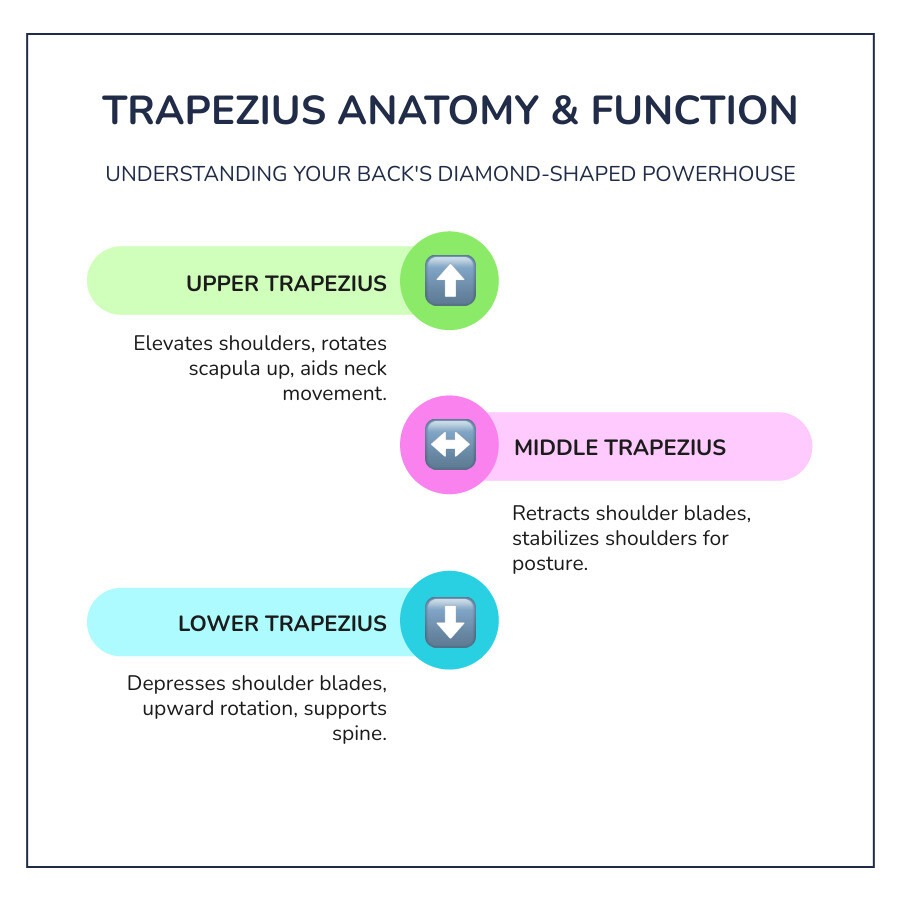
Basic exercise of trapezius terms:
Understanding Your Trapezius: Anatomy and Function
The trapezius, or "traps," is a large, trapezoid-shaped muscle extending from the base of the skull, across the shoulders, and down to the mid-back (Ourieff et al., 2021). It's a critical stabilizer for the shoulder blades and neck, playing a key role in most upper body movements.
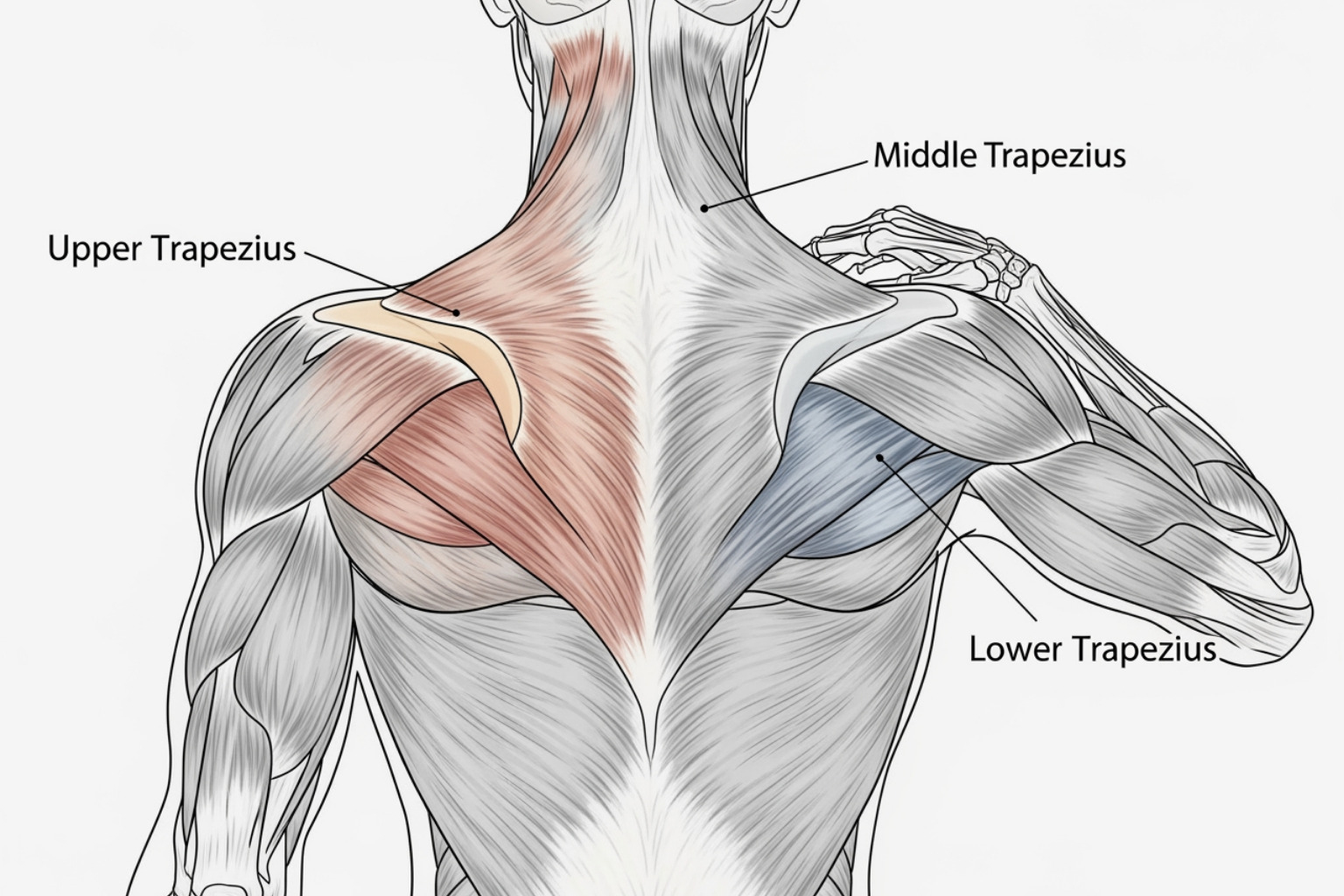
To master the exercise of trapezius, understand its three distinct sections, each with unique functions.
The Upper Trapezius (Superior Fibers)
These are the well-known fibers that create the sculpted look between your neck and shoulders. They originate from the base of the skull and cervical spine, attaching to the clavicle and scapula.
Primary functions:
- Scapular Elevation: Shrugging your shoulders.
- Upward Rotation: Helping rotate the shoulder blade when you raise your arm overhead.
- Neck Movement: Assisting in head and neck extension and rotation.
- Head Tilting: Tilting your head to the side.
The Middle Trapezius (Transverse Fibers)
Located between the shoulder blades, these fibers run from the thoracic vertebrae to the scapula. They are crucial for good posture and shoulder stability.
Key functions:
- Scapular Retraction: Pulling your shoulder blades together.
- Shoulder Blade Stability: Keeping the shoulder blades stable during arm movements.
- Postural Support: Preventing shoulders from rounding forward.
The Lower Trapezius (Inferior Fibers)
Forming the lowest part of the muscle, these fibers run from the lower thoracic vertebrae up to the scapula. Though often the weakest section, they are vital for shoulder health.
Main functions:
- Scapular Depression: Pulling the shoulder blades down.
- Upward Rotation: Working with the upper trapezius for overhead movements.
- Stabilizing the Spine: Aiding thoracic spine stability and preventing upper back rounding.
Understanding these roles is the first step toward a comprehensive exercise of trapezius program. For a deeper anatomical dive, consult resources like Anatomy of the Trapezius Muscle.
Why Strong Traps Matter: Benefits Beyond Aesthetics
While well-developed traps improve your physique, the benefits of the exercise of trapezius are far more critical for health, injury prevention, and athletic performance.
Improved Posture
Modern life often leads to poor posture, or "tech neck," from hunching over screens. This causes the upper traps to tighten while the middle and lower traps weaken, leading to a forward rounding of the upper spine (kyphosis). Strengthening the middle and lower trapezius helps counteract this by pulling your head, neck, and shoulders back into proper alignment. Research confirms a direct link between forward head posture and neck pain, making strong traps essential for a healthy posture.
Injury Prevention
The trapezius muscles are vital for stabilizing the shoulder blades. Weak or imbalanced traps can lead to improper shoulder blade movement (scapular dyskinesis), which places stress on the shoulder joint and increases injury risk. One study found that scapular dyskinesis increased the risk of shoulder injury by 8.4 times in elite athletes. Strong traps ensure the shoulder functions safely and efficiently. If you do experience a strain, it's helpful to understand more on trapezius strain treatment.
Improved Athletic Performance
Strong traps directly boost athletic performance. They act as key stabilizers during heavy lifts like deadlifts and overhead presses, enabling greater force production. They also provide a stable base for powerful movements like throwing, swinging, or punching, allowing other muscles to generate maximum power safely.
Who Benefits?
Virtually everyone benefits from a dedicated exercise of trapezius routine:
- Athletes: Improve power, stability, and injury resilience.
- Office Workers: Counteract the effects of prolonged sitting and "tech neck."
- Older Adults: Improve balance and stability, reducing fall risk.
- Pregnant Women: Maintain balance and support the spine as the body's center of gravity shifts.
The Ultimate Guide to the Exercise of Trapezius
A comprehensive exercise of trapezius program must target the upper, middle, and lower sections for balanced development. The following EMG-validated exercises are highly effective. Always prioritize form over weight, focusing on controlled movements and avoiding momentum or rolling the shoulders.
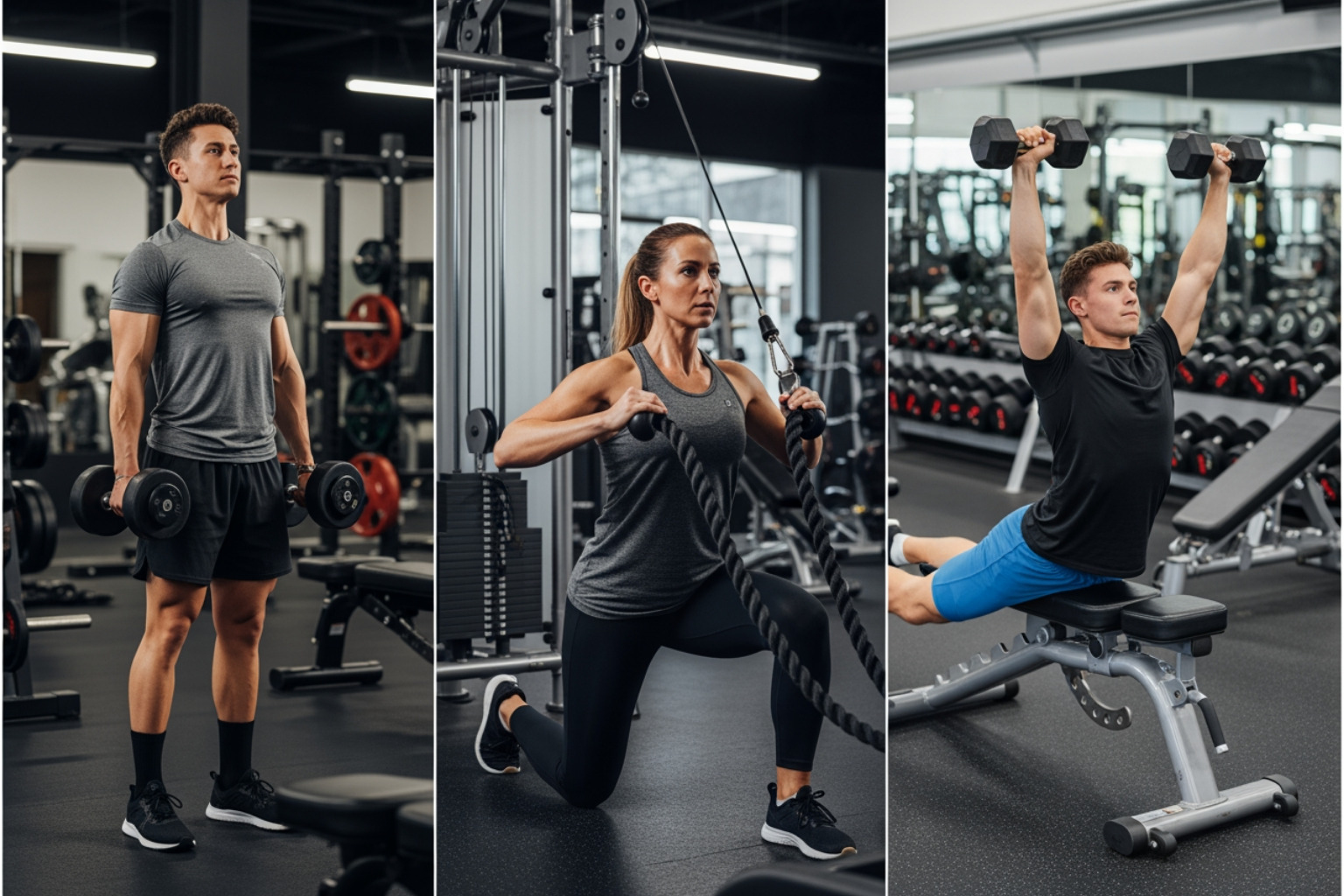
Targeting the Upper Trapezius
These exercises focus on scapular elevation.
Dumbbell/Barbell Shrugs: This classic isolation exercise maximizes upper trap activation. Stand tall holding dumbbells or a barbell. Without rolling your shoulders, shrug straight up towards your ears, squeeze at the top, and control the descent.
Upright Rows: This move engages the upper traps and deltoids. Hold a barbell or dumbbells with a narrow, overhand grip. Pull the weight straight up to your chin, leading with your elbows, and control the descent.
| Upper Trapezius Exercises (MVIC %) | |
|---|---|
| Scapular Shrug (Manual Resistance) | 120% |
| Farmer's Walk | 100% |
| Dumbbell Shrug | 90% |
| Upright Row | 80% |
(Based on data from John Snyder's MVIC values for UT exercises)
Effective exercise of trapezius: The Middle Fibers
These exercises emphasize scapular retraction for better posture.
Bent-Over Rows: A compound move that heavily engages the middle traps. Hinge at your hips with a straight back, holding a barbell or dumbbells. Pull the weight to your lower chest, squeezing your shoulder blades together.
Face Pulls: Excellent for shoulder health. Using a cable rope attachment at chest height, pull the rope towards your face, flaring your elbows out and squeezing your shoulder blades.
Seated Cable Rows: Builds back thickness and targets the middle traps. Sit with a straight back and pull the handle to your lower abdomen, initiating the pull by retracting your shoulder blades.
| Middle Trapezius Exercises (MVIC %) | |
|---|---|
| Shoulder Extension with Elbow Extension | 60% |
| Row with 45° Shoulder Abduction & 90° Elbow Flexion | 55% |
| External Rotation with 0° Shoulder Abduction | 48% |
| Row with 0° Shoulder Abduction & 90° Elbow Flexion | 44% |
| Row with 90° Shoulder Abduction & 90° Elbow Flexion | 40% |
(Based on data from John Snyder's MVIC values for MT exercises and provided statistics)
Strengthening the Lower Trapezius
These exercises target the often-neglected lower traps, focusing on scapular depression and upward rotation.
Y-Raises (Prone or Standing): This move specifically targets the lower traps. Lie face down on an incline bench or stand, holding light dumbbells. With straight arms, raise them up and out to form a "Y" shape, squeezing your lower shoulder blades.
Pull-ups/Chin-ups: These heavily engage the lower traps for stabilization. Initiate the pull by depressing and retracting your shoulder blades before pulling your chin over the bar.
Overhead Farmer's Walk: An incredible stability exercise. Hold a weight overhead with one arm locked out. Walk a set distance, keeping your core tight and shoulder stable, then switch arms.
For more detailed guidance, check out More lower trap exercises.
| Lower Trapezius Exercises (MVIC %) | |
|---|---|
| Prone Horizontal Abduction with External Rotation | 98% |
| Prone Y-Raise | 93% |
| Standing Y-Raise | 80% |
| Seated Cable Y-Raise | 75% |
| Overhead Farmer's Walk | 70% |
(Based on data from John Snyder's MVIC values for LT exercises)
Recovery and Flexibility: Stretches for a Healthier Back
Recovery is as important as the exercise of trapezius itself. Tight traps can cause discomfort and limit motion. Regular stretching alleviates tightness, improves blood flow, and promotes muscle health. When stretching, move gently, hold for 15-30 seconds, and never stretch into pain. For detailed guidance, see How to do upper trap stretches correctly.
Here are some effective trapezius stretches:
Ear-to-Shoulder Stretch: Sit or stand tall and gently tilt your head, bringing your ear toward your shoulder until you feel a stretch on the opposite side. For a deeper stretch, use your hand to apply light pressure. Hold for 20 seconds and repeat on the other side.
Cat-Cow Stretch: On all fours, inhale as you arch your back and look up (Cow). Exhale as you round your spine and tuck your chin (Cat). Flow between these poses for several repetitions to mobilize the spine and stretch the trapezius.
Hug Stretch (Cross-Body Stretch): Reach one arm across your chest to the opposite shoulder. Use your other hand to gently press down on the shoulder of the reaching arm while leaning your head away. Hold for 20 seconds, then switch.
Managing Soreness
Delayed Onset Muscle Soreness (DOMS) is normal after a tough workout. To manage it:
- Rest: Allow muscles time to recover.
- Heat and Cold Therapy: Use ice packs for inflammation and heat for muscle relaxation.
- Gentle Movement: Light activity like walking can reduce stiffness.
- Topical Pain Relief: For targeted relief, a natural cream like Neuropasil can soothe sore muscles. Powered by Aloe, Urea, and Menthol, it's used by athletes for fast recovery from aches and strains.
For more recovery strategies, explore Treating trapezius muscle strain.
Integrating Trap Training Into Your Workout Routine
Smart programming is key to getting the full benefits from the exercise of trapezius.
Frequency: How Often to Train Traps
For optimal muscle growth, research suggests training each muscle group more than once a week. A study found that training a muscle 2 or 3 times per week led to 3.1% greater growth compared to once-a-week training. Aim to train your traps 2-3 times per week, splitting the focus between the different sections.
Workout Splits: Pairing with Back Day vs. Shoulder Day
Since the trapezius falls between back and shoulder workouts, here's how to integrate it:
- Back Day: Add middle and lower trap exercises like face pulls and Y-raises after heavy rows, which already engage these muscles.
- Shoulder Day: Incorporate upper trap exercises like shrugs or upright rows, as they work in conjunction with the deltoids.
- Dedicated Focus: If traps are a priority, give them a short, focused session or split the work across two different workout days.
Sample Routine
Here’s a sample weekly integration:
-
Day 1 (Back/Middle & Lower Traps Focus):
- Deadlifts: 3 sets of 5-8 reps
- Bent-Over Rows: 3 sets of 8-12 reps
- Face Pulls: 3 sets of 12-15 reps
- Prone Y-Raises: 3 sets of 12-15 reps
-
Day 2 (Shoulders/Upper Traps Focus):
- Overhead Press: 3 sets of 6-10 reps
- Dumbbell Shrugs: 3 sets of 10-15 reps
- Upright Rows (light weight, focus on form): 3 sets of 10-12 reps
Progressive Overload and a Balanced Approach
To ensure growth, you must apply progressive overload by gradually increasing weight, reps, or sets. Maintain a balance between pushing and pulling movements in your overall routine to prevent muscular imbalances. Use unilateral exercises to correct any asymmetries and always listen to your body, prioritizing proper form and adequate rest to avoid overtraining.
Frequently Asked Questions about Trapezius Exercises
Can I train my traps every day?
No, this is not recommended. Muscles need time to recover to grow. Research shows that training a muscle 2 or 3 times per week results in greater muscle growth than training it only once. For optimal gains, focus on consistent training with adequate rest rather than daily sessions.
Should I lift heavy for my traps?
Yes, the traps can handle heavy loads, especially on compound lifts like deadlifts. However, technique is always the priority. For isolation exercises like shrugs, use a challenging weight that allows for a full range of motion and controlled movement. A mix of lower (8-12) and higher (15-20+) rep ranges is effective for growth.
How do I fix uneven traps?
Muscular imbalances, which often cause uneven traps, can be corrected with unilateral (single-arm) exercises. Incorporate single-arm dumbbell shrugs, single-arm rows, and one-arm overhead farmer's walks to target the weaker side. Always train the weaker side first, then match the reps on the stronger side to help it catch up.
Conclusion
The exercise of trapezius is fundamental to a healthy, functional, and pain-free upper body. By moving beyond simple shrugs to a balanced program that targets the upper, middle, and lower traps with exercises like rows, face pulls, and Y-raises, you can improve posture, prevent injury, and boost athletic performance. Remember to prioritize proper form, progressive overload, and adequate recovery.
A comprehensive approach to trapezius training will build a stronger, more resilient back. For post-workout soreness or strains, our natural, fast-acting topical creams can provide relief. Neuropasil, powered by Aloe, Urea, and Menthol, is designed to deliver targeted, soothing relief for sore muscles, strains, and aches.
Discover Neuropasil for muscle pain relief and use the power of natural, fast-acting ingredients to support your journey to a stronger, healthier you.
References
Ourieff, J., et al. (2021). Anatomy, Back, Trapezius. StatPearls. https://www.ncbi.nlm.nih.gov/books/NBK518994/; Mahmoud, N. F., et al. (2019). The Relationship Between Forward Head Posture and Neck Pain: a Systematic Review and Meta-Analysis. Current Reviews in Musculoskeletal Medicine. https://link.springer.com/article/10.1007/s12178-019-09594-y?fbclid=IwAR2A9tavzragZabEHCclxTPeI4QUl8dZ93utCk0fz3EqHPL3C3Mxmj5X2KY; Schoenfeld, B. J., et al. (2016). Effects of Resistance Training Frequency on Measures of Muscle Hypertrophy: A Systematic Review and Meta-Analysis. Sports Medicine. https://pubmed.ncbi.nlm.nih.gov/27102172/; Snyder, J. (n.d.). Best Exercises for the Trapezius. MedBridge. https://s3.amazonaws.com/medbridgemarketing/john-snyder/best+exercises+trapezius/John+Snyder+Chart+Upper+Trapezius.pdf; Cronin, J. (2019). Lower Trap Exercises: Strengthening Workouts. Healthline. https://www.healthline.com/health/fitness-exercise/lower-trap-exercises.