Introduction to Hamstring Tear Recovery
Exercises for hamstring tear recovery are essential for healing, but knowing which ones are safe and when to start them can be confusing. Here's what you need to know right away:
Safe Beginner Exercises for Hamstring Tear Recovery:
- Phase 1 (First 2 weeks): Hamstring sets (seated), quad sets, glute sets - gentle isometric holds
- Phase 2 (2-4 weeks): Prone hamstring curls, hip extensions, gentle doorway stretches, double leg bridges
- Phase 3 (4+ weeks): Single leg bridges, Romanian deadlifts (light), Swiss ball hamstring curls
- Key Rule: Start only when pain allows, progress slowly, and stop if sharp pain occurs
Hamstring injuries are incredibly common. Research shows that hamstring strains represent 37% of all muscle traumas in professional sports, making them the single most frequent muscle injury athletes face. But you don't have to be a professional athlete to experience this sharp, stopping pain in the back of your thigh.
The good news? Most hamstring tears heal well with the right approach. Whether you're dealing with a mild strain or a more serious partial tear, a structured exercise program is your path back to pain-free movement.
Because hamstring tears so often coexist with deep aching or burning along the back of the leg, people frequently look for fast-acting topical options like a muscle pain relief cream or nerve pain relief cream to take the edge off while they work through their rehab program. When used alongside the exercises in this guide, the right cream can make it more comfortable to move, sleep, and perform your daily activities, which in turn helps you stay consistent with your recovery plan.
This guide walks you through safe, effective exercises for each stage of hamstring tear recovery. We'll cover everything from immediate care in the first 48 hours to advanced strengthening exercises that prevent re-injury. You'll learn which movements help healing, which ones to avoid, and exactly when to progress from one phase to the next.
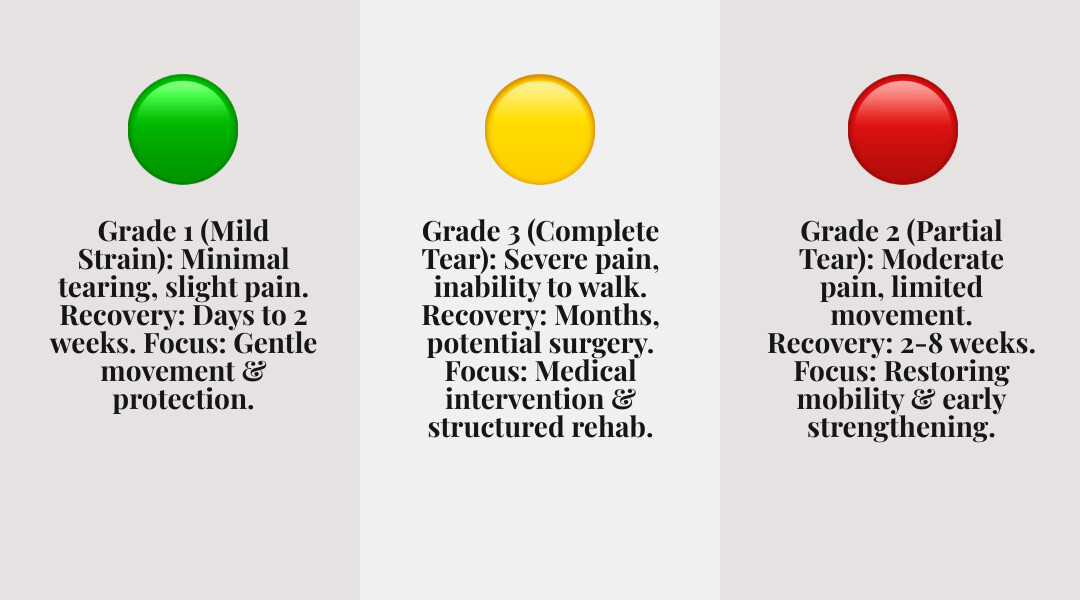
Understanding the grades of hamstring tears is crucial for your recovery:
- Grade 1: Mild strain with minimal tearing - typically heals in days to 2 weeks
- Grade 2: Partial muscle tear with moderate pain and limited motion - recovery takes 2-8 weeks
- Grade 3: Complete muscle tear, severe pain, can't walk - may require surgery, months of recovery
The key to successful recovery isn't rushing back to activity. It's following a phased approach that respects your body's healing timeline while keeping muscles active enough to prevent stiffness and weakness.
I'm Tony Enrico, and through my work helping thousands find relief from muscle and nerve pain, I've seen how proper exercises for hamstring tear recovery, combined with smart pain-relief strategies like targeted muscle pain relief creams and nerve pain relief creams, can make the difference between full healing and chronic reinjury. My mission with Neuropasil has always been to provide not just products, but practical guidance that helps people reclaim their active lives.
Exercises for hamstring tear further reading:
References
- Ekstrand J, Hägglund M, Waldén M. Epidemiology of muscle injuries in professional football (soccer). Am J Sports Med. 2011;39(6):1226–1232. https://doi.org/10.1177/0363546510395879
- American Academy of Orthopaedic Surgeons (AAOS). Hamstring Muscle Injuries. OrthoInfo. Accessed 2024. https://orthoinfo.aaos.org/en/diseases--conditions/hamstring-muscle-injuries
- Askling CM, Tengvar M, Thorstensson A. Acute hamstring injuries in Swedish elite football: a prospective randomised controlled clinical trial comparing two rehabilitation protocols. Br J Sports Med. 2013;47(15):953–959. https://bjsm.bmj.com/content/47/15/953
- Cleveland Clinic. Hamstring Injury: Recovery, Treatment & Prevention. Accessed 2024. https://my.clevelandclinic.org/health/diseases/17039-hamstring-injury
- Mayo Clinic. Muscle strains. Accessed 2024. https://www.mayoclinic.org/diseases-conditions/muscle-strains
Understanding Your Hamstring Injury and When to See a Doctor
Before we dive into specific exercises for hamstring tear recovery, it’s vital to understand what hamstrings are, what happens when they tear, and when you absolutely need professional medical attention. Knowing your injury is the first step toward a successful recovery.
Hamstring Anatomy and Function
Our hamstrings are a group of three powerful muscles located at the back of your thigh: the biceps femoris, semitendinosus, and semimembranosus. These muscles originate from the ischial tuberosity (the bony part of your pelvis you sit on) and extend down to attach below your knee joint. This unique anatomical arrangement means they cross both the hip and knee joints.
Their primary functions are:
- Bending the knee: Think about walking, running, or kicking a ball.
- Extending the hip: This is crucial for movements like pushing off the ground or standing up.
They also play a critical role in controlling movement across all three planes of motion (sagittal, frontal, and transverse), making them prime movers in locomotion, running, cutting, and jumping. For a deeper dive into the mechanics of these vital muscles, check out our article on Hamstring Anatomy 101: Everything You Need to Know About Your Thigh Muscles.
What is a Hamstring Tear?
A hamstring tear, often referred to as a "pulled hamstring" or "hamstring strain," occurs when the muscle fibers are overstretched beyond their capacity, leading to microscopic or macroscopic tearing. It's a soft-tissue injury that can range from mild damage to a complete rupture. These injuries are particularly common in sports that involve sudden acceleration, deceleration, or explosive movements, such as sprinting, soccer, basketball, and track and field.
We classify hamstring tears into different grades of severity:
- Grade 1 (Mild Strain): This is the least severe form, involving minor overstretching or tearing of only a few muscle fibers. You might feel a sudden ache or tightness in the back of your thigh. While painful, you can usually walk without severe difficulty, though movement might be uncomfortable.
- Grade 2 (Partial Tear): This involves a more significant tear, affecting a moderate number of muscle fibers. You'll likely experience sharper pain, swelling, and tenderness. Walking will be difficult and painful, and you might notice some bruising. There's often a noticeable loss of strength and range of motion.
- Grade 3 (Complete Tear): This is the most severe type, where the muscle or its tendon is completely torn, sometimes pulling away from the bone (avulsion fracture). You'll typically feel a sudden, intense, sharp pain, possibly accompanied by a "popping" or "snapping" sensation at the time of injury. There will be significant swelling, bruising, and you'll likely be unable to walk or put weight on the affected leg. This grade often requires surgical intervention.
Common Symptoms
Recognizing the symptoms of a hamstring tear early can help you seek appropriate care. Common signs include:
- Sudden, sharp pain: Often felt during activity, sometimes described as a "stabbing" sensation.
- Popping or snapping sensation: This is a strong indicator of a Grade 2 or 3 tear at the moment of injury.
- Tenderness to the touch: The injured area will feel sore when pressed.
- Swelling: Often develops rapidly in the hours following the injury.
- Bruising: Discoloration may appear days after the injury as blood pools under the skin.
- Weakness: Difficulty extending the hip or bending the knee, or a general feeling of instability.
- Stiffness: Limited range of motion in the hip or knee.
- Difficulty walking or bearing weight: This is especially true for more severe tears.
For more detailed guidance on identifying these symptoms, refer to our article: 5 Simple Steps to Identify Hamstring Pull Symptoms.
Causes and Risk Factors
Hamstring strains typically occur due to muscle overload, especially during eccentric contractions (when the muscle lengthens while contracting, like when decelerating from a sprint). Several factors can increase your risk:
- Muscle tightness: Poor flexibility means your hamstrings are already under tension and more prone to tearing when stretched forcefully.
- Muscle imbalance: If your quadriceps (front thigh muscles) are significantly stronger than your hamstrings, this imbalance can put undue stress on the hamstrings.
- Poor conditioning: Inadequate strength, endurance, or flexibility for the activity you're performing.
- Fatigue: Tired muscles are less able to absorb energy and are more susceptible to injury.
- Insufficient warm-up: Muscles that haven't been properly warmed up are less elastic and more prone to tearing.
- Rapid increase in activity: Suddenly ramping up intensity, duration, or frequency of exercise without allowing your body to adapt.
- Prior hamstring injury: A history of hamstring strains significantly increases the risk of re-injury.
The American Academy of Orthopaedic Surgeons (AAOS) highlights these factors, noting that hamstring muscle injuries are especially common in athletes who participate in sports requiring sprinting and explosive movements. For further insights into the causes and risk factors, consult Hamstring Muscle Injuries - OrthoInfo - AAOS.
Red Flag Symptoms: When to Seek Professional Medical Help
While mild hamstring strains can often be managed at home, certain symptoms warrant immediate medical attention. We always advise consulting a healthcare professional for an accurate diagnosis and personalized treatment plan, especially in New York City where access to top-tier sports medicine specialists and physical therapists is readily available.
Seek professional medical help if you experience:
- Severe pain: Pain that makes it impossible to move your leg or bear weight.
- Inability to walk: If you cannot walk even a few steps without severe pain.
- Large amount of swelling or bruising: Especially if it's worsening rapidly.
- A distinct "pop" or "snap" at the time of injury: This suggests a more severe tear.
- Sudden numbness or tingling: This could indicate nerve involvement.
- Injury not improving: If your symptoms do not start to subside within a few days of self-care.
- Signs of infection: Redness, warmth, pus, or a fever.
Ignoring these red flags can lead to prolonged recovery or chronic issues. Your doctor can perform a physical exam, and if necessary, order imaging tests like an X-ray (to rule out avulsion fractures), ultrasound, or MRI (to visualize the extent of the muscle tear).
Here’s a quick comparison of the grades to help you understand what to expect and when to act:
| Grade | Symptoms | Typical Recovery Time | Recommended Action ```
Introduction to Hamstring Tear Recovery
Exercises for hamstring tear recovery are essential for healing, but knowing which ones are safe and when to start them can be confusing. Here's what you need to know right away:
Safe Beginner Exercises for Hamstring Tear Recovery:
- Phase 1 (First 2 weeks): Hamstring sets (seated), quad sets, glute sets - gentle isometric holds
- Phase 2 (2-4 weeks): Prone hamstring curls, hip extensions, gentle doorway stretches, double leg bridges
- Phase 3 (4+ weeks): Single leg bridges, Romanian deadlifts (light), Swiss ball hamstring curls
- Key Rule: Start only when pain allows, progress slowly, and stop if sharp pain occurs
Hamstring injuries are incredibly common. Research shows that hamstring strains represent 37% of all muscle traumas in professional sports, making them the single most frequent muscle injury athletes face. But you don't have to be a professional athlete to experience this sharp, stopping pain in the back of your thigh.
The good news? Most hamstring tears heal well with the right approach. Whether you're dealing with a mild strain or a more serious partial tear, a structured exercise program is your path back to pain-free movement.
This guide walks you through safe, effective exercises for each stage of hamstring tear recovery. We'll cover everything from immediate care in the first 48 hours to advanced strengthening exercises that prevent re-injury. You'll learn which movements help healing, which ones to avoid, and exactly when to progress from one phase to the next.
Understanding the grades of hamstring tears is crucial for your recovery:
- Grade 1: Mild strain with minimal tearing - typically heals in days to 2 weeks
- Grade 2: Partial muscle tear with moderate pain and limited motion - recovery takes 2-8 weeks
- Grade 3: Complete muscle tear, severe pain, can't walk - may require surgery, months of recovery
The key to successful recovery isn't rushing back to activity. It's following a phased approach that respects your body's healing timeline while keeping muscles active enough to prevent stiffness and weakness.
I'm Tony Enrico, and through my work helping thousands find relief from muscle and nerve pain, I've seen how proper exercises for hamstring tear recovery can make the difference between full healing and chronic reinjury. My mission with Neuropasil has always been to provide not just products, but practical guidance that helps people reclaim their active lives.
Exercises for hamstring tear further reading:
- anatomy of hamstrings
- torn hamstring muscle treatment
Understanding Your Hamstring Injury and When to See a Doctor
Before we dive into specific exercises for hamstring tear recovery, it’s vital to understand what hamstrings are, what happens when they tear, and when you absolutely need professional medical attention. Knowing your injury is the first step toward a successful recovery.
Hamstring Anatomy and Function
Our hamstrings are a group of three powerful muscles located at the back of your thigh: the biceps femoris, semitendinosus, and semimembranosus. These muscles originate from the ischial tuberosity (the bony part of your pelvis you sit on) and extend down to attach below your knee joint. This unique anatomical arrangement means they cross both the hip and knee joints.
Their primary functions are:
- Bending the knee: Think about walking, running, or kicking a ball.
- Extending the hip: This is crucial for movements like pushing off the ground or standing up.
They also play a critical role in controlling movement across all three planes of motion (sagittal, frontal, and transverse), making them prime movers in locomotion, running, cutting, and jumping. For a deeper dive into the mechanics of these vital muscles, check out our article on Hamstring Anatomy 101: Everything You Need to Know About Your Thigh Muscles.
What is a Hamstring Tear?
A hamstring tear, often referred to as a "pulled hamstring" or "hamstring strain," occurs when the muscle fibers are overstretched beyond their capacity, leading to microscopic or macroscopic tearing. It's a soft-tissue injury that can range from mild damage to a complete rupture. These injuries are particularly common in sports that involve sudden acceleration, deceleration, or explosive movements, such as sprinting, soccer, basketball, and track and field.
We classify hamstring tears into different grades of severity:
- Grade 1 (Mild Strain): This is the least severe form, involving minor overstretching or tearing of only a few muscle fibers. You might feel a sudden ache or tightness in the back of your thigh. While painful, you can usually walk without severe difficulty, though movement might be uncomfortable.
- Grade 2 (Partial Tear): This involves a more significant tear, affecting a moderate number of muscle fibers. You'll likely experience sharper pain, swelling, and tenderness. Walking will be difficult and painful, and you might notice some bruising. There's often a noticeable loss of strength and range of motion.
- Grade 3 (Complete Tear): This is the most severe type, where the muscle or its tendon is completely torn, sometimes pulling away from the bone (avulsion fracture). You'll typically feel a sudden, intense, sharp pain, possibly accompanied by a "popping" or "snapping" sensation at the time of injury. There will be significant swelling, bruising, and you'll likely be unable to walk or put weight on the affected leg. This grade often requires surgical intervention.
Common Symptoms
Recognizing the symptoms of a hamstring tear early can help you seek appropriate care. Common signs include:
- Sudden, sharp pain: Often felt during activity, sometimes described as a "stabbing" sensation.
- Popping or snapping sensation: This is a strong indicator of a Grade 2 or 3 tear at the moment of injury.
- Tenderness to the touch: The injured area will feel sore when pressed.
- Swelling: Often develops rapidly in the hours following the injury.
- Bruising: Discoloration may appear days after the injury as blood pools under the skin.
- Weakness: Difficulty extending the hip or bending the knee, or a general feeling of instability.
- Stiffness: Limited range of motion in the hip or knee.
- Difficulty walking or bearing weight: This is especially true for more severe tears.
For more detailed guidance on identifying these symptoms, refer to our article: 5 Simple Steps to Identify Hamstring Pull Symptoms.
Causes and Risk Factors
Hamstring strains typically occur due to muscle overload, especially during eccentric contractions (when the muscle lengthens while contracting, like when decelerating from a sprint). Several factors can increase your risk:
- Muscle tightness: Poor flexibility means your hamstrings are already under tension and more prone to tearing when stretched forcefully.
- Muscle imbalance: If your quadriceps (front thigh muscles) are significantly stronger than your hamstrings, this imbalance can put undue stress on the hamstrings.
- Poor conditioning: Inadequate strength, endurance, or flexibility for the activity you're performing.
- Fatigue: Tired muscles are less able to absorb energy and are more susceptible to injury.
- Insufficient warm-up: Muscles that haven't been properly warmed up are less elastic and more prone to tearing.
- Rapid increase in activity: Suddenly ramping up intensity, duration, or frequency of exercise without allowing your body to adapt.
- Prior hamstring injury: A history of hamstring strains significantly increases the risk of re-injury.
The American Academy of Orthopaedic Surgeons (AAOS) highlights these factors, noting that hamstring muscle injuries are especially common in athletes who participate in sports requiring sprinting and explosive movements. For further insights into the causes and risk factors, consult Hamstring Muscle Injuries - OrthoInfo - AAOS.
Red Flag Symptoms: When to Seek Professional Medical Help
While mild hamstring strains can often be managed at home, certain symptoms warrant immediate medical attention. We always advise consulting a healthcare professional for an accurate diagnosis and personalized treatment plan, especially in New York City where access to top-tier sports medicine specialists and physical therapists is readily available.
Seek professional medical help if you experience:
- Severe pain: Pain that makes it impossible to move your leg or bear weight.
- Inability to walk: If you cannot walk even a few steps without severe pain.
- Large amount of swelling or bruising: Especially if it's worsening rapidly.
- A distinct "pop" or "snap" at the time of injury: This suggests a more severe tear.
- Sudden numbness or tingling: This could indicate nerve involvement.
- Injury not improving: If your symptoms do not start to subside within a few days of self-care.
- Signs of infection: Redness, warmth, pus, or a fever.
Ignoring these red flags can lead to prolonged recovery or chronic issues. Your doctor can perform a physical exam, and if necessary, order imaging tests like an X-ray (to rule out avulsion fractures), ultrasound, or MRI (to visualize the extent of the muscle tear).
Here’s a quick comparison of the grades to help you understand what to expect and when to act:
| Grade | Symptoms | Typical Recovery Time | Recommended Action ```